Friday, April 10, 2015

Week 1; Marzano and Hattie's Strategies are the Bridge to the Future.

Week 1’s assignment was reflective and informative. My district was really into Marzano when we started unwrapping standards about ten years ago so I felt really good when I was familiar with many strategies. However, I learned from out chart that there are many ways to incorporate these using technology! I liked the idea of the Haiku Deck and Google drawing that Josh and Jody shared for non linguistic representation strategy.

I feel as if the integration of technology can assist teachers in making summative assessments align with the common core. For example, using wiki or Google docs to assess summarizing and note taking is much more efficient and effective than it could have been ten years ago when these technologies did not exist. The same can be said for many for many of the non linguistic representation ideas others posted. This alignment is important because it allow teachers to access and get to more students in a shorter amount of time. Hence, allowing more time for teachers to teach, re-teach, and engage with students instead of grading assessments.

Marzano and Hattie’s strategies are simply good teaching. They are good for the CCSS because they promote independent thinking, an important aspect of the CCSS and 21st century learning skills. Collaborative learning and self-assessment are strategies that will allow students to communicate and develop autonomy as they progress through their k-12 years of school. By employing these strategies at a young age and developing their effectiveness as students grow, we can build employable adults. Using effective questioning strategies will help develop independent thinkers that will allow students to utilize these strategies on their own once they are in college and the work force. These are all goals of the common core and using the Marzano and Hattie strategies are the best practices to reach our goals.

Sunday, March 29, 2015

Personal Online Case Study

Personal Online Case Study
Monica Hayes

Over the past nine months, I have broadened and extended my knowledge of the online world in regards to education. Google has opened my eyes to a whole new way of communication that I never before utilized. I have employed teaching strategies using the likes of Storify, Google Docs, Google Groups, and Powtoon. I have also dabbled in Wiki’s collected online MOOC badges, used Twitter educationally, and started to globalize my teaching. Communicating with students and teachers through different online mediums has helped develop my skills in creating an online or blended learning atmosphere.
Using Google as the base of this program has spilled over into my classroom teaching. Students are communicating through email for assignments. They have Tweeted responses to content-related questions, and have created multiple assignments in different mediums for me. As I continue through this year, I have constantly tried to challenge the way students produce material. Instead of writing traditional essays, they have created Storifies. Communicating with others has not only been done through verbal discussions in class, they have used Google Groups to respond to me and others, while prompting each other to think further. Exposing students to these types of communication, mediums, and technological devices has created a better atmosphere. STudents, when given the choice, more frequently choose a technological device to produce work as opposed to paper and pencil.
I believe my knowledge of Google and ability to navigate and communicate and create lessons is a great advantage and would be quite effective in a blended learning environment. I have already utilized these aspects in my teaching within the past months. Sharing documents, commenting and suggesting on students papers, and using email with students has made teaching in the 21st century more effective and beneficial to all. Using the backwards design model of creating essential questions with direct objectives  that focus on understanding the curriculum is a core value of blended learning. The common core is very blended learning - adaptive. In creating lessons and units based on the common core and blended learning model, the students will have a better opportunity to develop autonomy in their learning. This is a strength as all of my curricula taught has been developed using the backwards design. AS we continue to grow in this “industrial age” of education, more and more students are becoming dependent on technology. However, in class, they are still dependent on the teacher. In the shift to blended learning, students can own their education more than they can in a clasroom. The teacher has the ability to teach material, then facilitate as students navigate through the information to gain their knowledge. This is more and more the trend of how we communicate in today’s world. As technology continues to increase, more job positions are global than ever before. USing the blended model alone is practice for our students’ futures! Being able to take material and synthesize an answer autonomously is the goal of blended learning, and essentially, preparing for the job market.  
Using my learning hub more frequently is something that would I would need to improve to be an effective online teacher. The blended learning model needs a home where students and teachers can access for the latest and most up-to-date material. As I continue through this program at UNH, my hub continues to grow. I can, and have, uploaded lessons, worksheets, announcements for students to access.
For the blended learning model to be a success, I would need all students to have access to the web. For some, this is still an issue and in lessons I have recently taught using Twitter, there were issues for students without access. Furthermore, based on contracts and budgets, etc. I know teaching an online class would require changes be made to our contracts, or more money for teaching an online class. This is bound to create waves with either the teachers’ union, the board of education, or both. That is probably the biggest issue in creating an online class for our district.
Personalizing learning is another aspect of the blended model that would be modified. Using the blended model has advantages to personalizing learning. Using Google has been most beneficial to me as a teacher in regards to my special education population. SCaffolding and supporting students with modifications has become more easily accomplished using the technology. The blended model would allow me to modify material more efficiently for certain populations.
I also believe using MOOC badges as a source of credit for class could be an integral part of integrating and developing a blended learning atmosphere. I find the challenge with using badges as finding a way to show students they hold value. If a class credit can be used, it would be a source of motivation to take a blended learning course as students would need the credit to graduate. Otherwise, I wonder if students would choose to take a traditional class over the blended learning class because they are more familiar with that model.
Using the blended model would also change my accessibility. I would have to accept that students would need to, or could, reach me all hours of the day. In traditional settings, teachers are available until the bell rings. However, I have noticed just just this year, as I have created a more online/blended environment by using Twitter, Google Docs, Groups, and email, students are requesting my assistance outside of the walls and hours of the school. This is something that I have had to adjust to and remind myself to check my email nightly to see if anyone needs help. This would be a must in a blended learning class.
In reflecting, I have found that I would be an effective blended learning teacher. Professionally, I am more and more qualified as I make my way through this 6th year program. However, this reflection has showed me that I would embrace being a blended, online teacher. I hope to be one of the first to teach an online class in my district and just recently, I was put in charge of researching this very task, per my assistant principal!

Friday, March 6, 2015

#walkmyworld It's Like You're My Mirror!

http://youtu.be/EFzQo3h1q3M
What do I see in the mirror? Well I wish Justin Timberlake was looking back at me and singing this song for me but, sadly, he isn't. What I see in my reflection is a mixture of hope for the future, pride for the present and wrinkles from my past! But that's why there's makeup! I am proud that I get to go to work everyday and grateful I have a job in something I enjoy doing. I also find pleasure and comfort in knowing that I am allowed to teach at a school that is very welcoming and tolerant. Enjoying the people you work with is a huge part of how I feel when I look in the mirror. I can't imagine what it's like to look in the mirror and dread the rest of the day! I am also hopeful that one day I will be able to share my pride and enjoyment with my knight in shining armor aka my Justin Timberlake!

Wednesday, February 25, 2015

#walkmyworld Week 6 Dreams

 I dream about things I am stressed about. Most of the time it wakes me up and I stay awake for hours! I am the worst sleeper. I have, numerous times, considered partaking in an insomnia or sleep pattern study!

I often look similar to this guy in the picture, unfortunately, with bags under his eyes. I do not lead a very stressful life but when things in life bother me or I can't get them off my mind, I think about them constantly when I am sleeping. Last night I was thinking about my upcoming schedule which includes work, class, coaching basketball, preparing for the softball season that is quickly approaching, making sure I don't forget to send my grandmother flowers for a procedure she just had (and now that I am writing this I realize I DID forget!) and visiting my friend who is having a surgery on Friday. Like I said, nothing too major that is keeping we awake but it infuses itself into my dreams. I dreamt I was running, yet not going anywhere. That happens often, I think, because that is how I feel! I chose the runner specifically running in the dark because I don't see things in my dream; I'm just running. the dark represent the helplessness I feel and lack of accomplishment in forgetting to do things. These things I forget are what haunt my dreams and keep me awake.

Night Extension Wksht

Name:
Holocaust Extension Reading: Night, "Race" and "For the Living and the Dead"

1.            Elie Weisel wrote Night and, "For the Living and the Dead". Which of the following statements do you find to be true of each piece of writing?
a. Both pieces were intended to entertain readers.
b. While Night informed readers about his experience, "For the Living..." was intended to plead with the public to remember the Holocaust.
c. They are both written in first person, yet for different audiences.
d. "For the Living..." is a speech and Night is a novel.
e. They both intend to discuss the Holocaust's impact.

2.            In reading both, "Race" and "For the Living and the Dead," what similar messages do they both                 personify? (Choose 2).
a. The Holocaust should not be forgotten
b. Hatred is the source of much pain and suffering in the world
c. Hope will keep you alive
D. Don't give up

3.            Choose one of your answers from Part A that most resembles a theme statement and elaborate             on how each source implicates the theme. Use quotes you feel most powerfully personify the theme from both "Race" and "For the Living and the Dead".


4.            After reading the two sources, in your opinion, do you think the world has learned anything       from the Holocaust and its consequences? Explain using information from both "Race" and "For       the Living and the Dead".


Friday, February 6, 2015

#walkmyworld Reflection

#Walkmyworld week 3

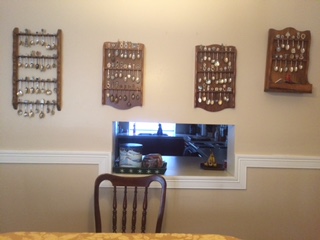
spoon reflection.jpg

I have a hobby; I collect spoons from places I’ve traveled. My hobby has been the brunt of many jokes over the years as people find out about this hidden hobby of mine. Most of the time I get called an old lady; apparently spoon collecting is associated with older women! I will say that the only clientele of humans to NOT poke fun at me ARE older ladies! So, maybe there’s some truth to the joking banter but it hasn’t stopped me from gathering spoons from places I’ve visited from the age of 9 when I bought a spoon at a museum in Williamsport, PA while watching the Little League World Series. I have since collected almost 100 spoons spanning the globe.

Referencing Tupac’s poem, “Did you hear about the rose that grew from a crack?” reminds me of how my hobby has transformed itself into a phenomenon within my circle of friends and family. I laugh when others make fun of me because my hobby has indirectly become a hobby of my friends and family. When they go on vacation, they buy ME spoons! I have spoons from France, a place I’ve never been and others from places such as Aruba, Rhode Island, Florida, Bahamas, California - to name a few.
IMG_0055.JPG
“...to feel exposed to the madness…” from Identity is what I feel like when I look a

Wednesday, January 14, 2015

Week 2, ED 722: Online Learning Theories

Week 2, ED 722: Online Learning Theories

I do agree with the idea that interactions, environment and connections play a role in how effective technology can be in education. Strictly utilizing teacher to student, or student to student interaction is not always the best avenue to success. Just like you would not use the same teaching strategy every day for every lesson you teach, you should vary the types of technology and the ways in which you use technology for it to be effective in the classroom.

Sometimes behaviorism is valuable. We use it when we respond to prompts for our online learning. Cognitivism is valuable when we are trying to use a new tool. LEarning Skitch this summer was an area where students utilized this type of learning. In order to engage with material, Constructivism was used. Last semester we were directors of discussions and tried using new mediums while also defending why we used such medium for ED 7718. Creating our learning hub, accessing and building our personal learning network, and using our MOOC’s are part of connectivism.

I have found from watching the video we are utilizing all the theories and mostly trying to become experts in the latest, connectivism, field. Being able to rework our learning hub or reformat our blogs is a way of utilizing the connectivism strategy as we are constantly self-reflecting. This is a higher order thinking skill that would have to be honed from a young age if we really want our students to be able to perform at this level.

“Learners will not learn from simulations if the simulations are not developed using sound principles.” This quote from the Ally article encompasses the material for this week, in my opinion. It is not a matter of using new and creative teaching strategies or a matter of using the latest instructional technology. It IS a matter of using both, together, in varying fashions. The four learning strategies are beneficial and needed in education, but they need to be used together to help all students become successful.

Being part of this program has helped me create a more technology-friendly environment in my classroom. Prior to, I used technology to teach, but my students were not necessarily using technology to learn. I am now in the process of creating lesson using varying strategies that match the technology I have access to and making sure my students are being assessed using technology as well.